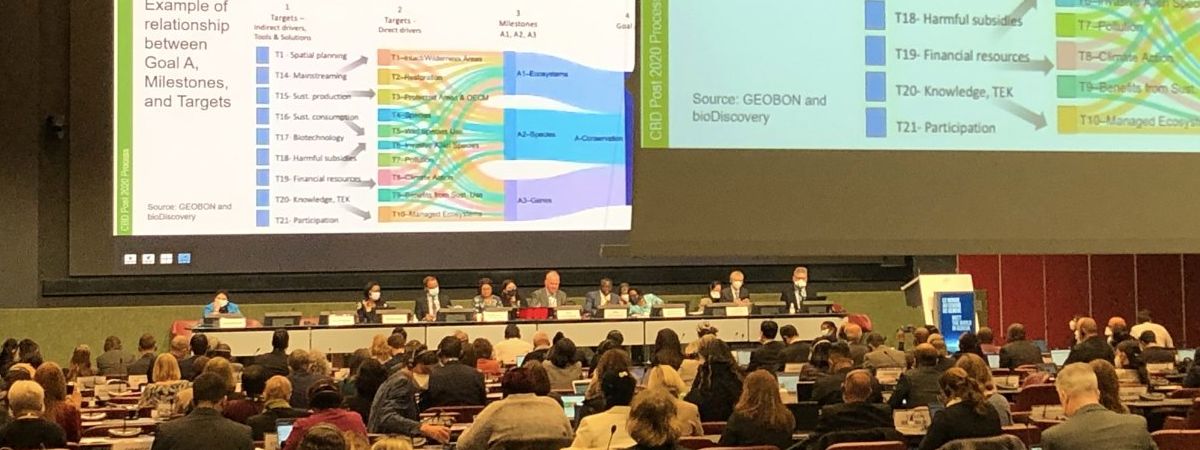
Avaaz will be sending you daily updates from the CBD Geneva meetings of SBSTTA-24, SBI-3 and the OEWG-3 as it unfolds over the next few weeks. We’ll be working hard to bring you useful information, insights, reports and opportunities for all stakeholders (Parties and non-Parties alike) to contribute for meaningful, more inclusive and transparent negotiations.
We hope you enjoy it!
The Avaaz Team
----------------------------------
Saturday, March 26th, 2022
What’s new?
Crunch time:
There’s a lot for the CBD to get through this weekend, with sessions expected to drag on until the early hours of the morning on both Saturday and Sunday.
Avaaz is optimistic that delegates can knuckle down and at least come to an agreement on the most pressing and important agenda items. Others here in Geneva have told us they are not so sure, calling the late night sessions, “mind-numbing” to the point where many people have had to leave as they are borderline delirious and no longer able to fully focus and follow the discussions.
We’re calling on ALL delegates not to miss the train here in Geneva. We CAN’T leave these important texts covered in brackets for COP15 to decide on - months from now.
The planet is running out of time, and so is the CBD convention in Geneva, as the conference ends this Tuesday.
Today’s agenda items:
At 10am
: The SBI-3 Plenary addressed five agenda items:
-
CRP.15/Rev.1
(resource mobilisation).
-
CRP.20
(financial mechanism).
-
CRP.13/Rev.1
(capacity-building and development, technical and scientific cooperation and technology transfer).
-
CRP.5/Rev.1 (options to enhance planning, reporting, and review mechanisms with a view to strengthening the implementation of the Convention).
-
Draft recommendation
(submitted by the Chair of the Subsidiary Body on Implementation).
Also on the table for discussion today:
-
CRP.18
(gender plan of action for the post-2020 global biodiversity framework).
-
CRP.14/Rev.1
(implementation and capacity-building action plan for the Cartagena Protocol).
-
CRP.17
(communication for the GBF).
-
CRP.9
(other matters related to the GBF).
Mainstreaming:
-
CRP.8
(engagement with subnational governments, cities and other local authorities to enhance implementation of the post-2020 global biodiversity framework).
-
CRP.16
(mainstreaming of biodiversity within and across sectors and other strategic actions to enhance implementation).
At 3pm
: The WG2020-3 Contact Group 3 will address
Targets 9-13
of the GBF.
At 7.30pm
: The WG2020-3 Contact Group 4 will address Targets 14-21 and sections H to K of the GBF, going separately through:
Highlights from Friday’s sessions:
A Christmas tree of brackets
On Friday afternoon, the Working Group for the post-2020 framework reconvened. They had one goal: agree on the new versions of targets 1-8 based on a non-paper provided by the Secretariat.
We don’t want to repeat ourselves, but it’s become very clear that governments cannot agree on the simplest and most effective text. Parties were able to double, and sometimes triple the size of the paragraphs with too many brackets. Targets 4, 5, and 6 were discussed. When negotiations for Target 1 began, the meeting was over.
The highlight of the session was the confusion expressed by many Parties that referred to the negotiations as a “brainstorm”, instead of a negotiation, with some referring to the paragraphs as a "Christmas tree of brackets".
To our disappointment, there are no presents under this tree.
Destructuring the framework – to water it down?
If one wanted to take the measure of the amount of work that is still needed on the post-2020 global biodiversity framework, the Friday night meeting of Contact Group 1 (Goals, overall structure, sections A to E) was probably the perfect place.
The contact group lasted until 2:30 am, and it’s virtually the whole structure of the framework that was discussed, with some major reshuffling that was proposed by different Parties.
As a reminder, one of the innovative features of the GBF is to have 2050 “outcome goals”, that are basically describing what we would want the world to look like in 2050. They concern the state of biodiversity, the benefits it provides to people, access and benefit sharing of the benefits derived from the utilization of genetic resources, and the mobilization of financial resources for biodiversity.
These goals, with quantitative elements, are supposed to make more tangible the 2050 Vision adopted in 2010 of “Living in harmony with nature”. Having quantitative elements is meant to enable the tracking of progress towards achieving these goals.
The “2030 milestones” are intermediary steps in this journey. Again, the idea is to have tangible intermediary endpoints for this decade, in order to better track progress on the results.
Then, the “2030 action targets” are describing the actions to be taken to achieve the 2050 goals (and thus the 2030 milestones).
This basic structure has been on the table since January 2020 (!) and the zero draft of the GBF. What happened last night is that several Parties started to completely modify the structure: asking to suppress milestones because it made the framework “too complicated”, asking to move the milestones inside the targets so that everything that has to do with 2030 is at the same place, and some even started to take away the quantitative elements of the 2050 goals, to make them “aspirational” - but thus taking much of their teeth away…
This is a big deal, and it has notably alarmed the scientists following the negotiations. If we want more transparency in the implementation of the post-2020 GBF, it needs to be as measurable as possible. The idea of having SMART (Specific, Measureable, Ambitious, Realistic and Time-bound) goals and targets has guided the development of the GBF so far.
We also need clarity on what we want to achieve (like in the Paris Agreement, the long-term temperature goals of 1.5°C or 2°C of global warming) and the actions to put in place (again, like in the Paris Agreement, the reduction of greenhouse gas emissions that are addressed in its article 4.1). What we are trying to achieve with the GBF is complex, both on the outcomes and the actions to put in place. Following each separately will be challenging enough, conflating both will make things unnecessarily difficult.
To understand better the connections between 2030 targets and 2050 goals, and why milestones are important, have a look at this report prepared for the Geneva meetings by more than 50 international scientific experts.
TGI Fry-day
A moment of laughter lit up the room and relaxed the tension lingering over these negotiations when the Secretariat accidentally typed "eggs, fries” instead of "eggs, frys" in the non-paper, as a delegate suggested language for target 5.
We hope cracking up and having some much-needed fun over a good joke ( “yolk”?) helped work up an appetite for a cleaner text, as much as it left many of us in the room feeling hungry that things might eggs-celerate.
----------------------------------
Friday, March 25th, 2022
What’s new?
10am:
The SBSTTA-24 Plenary addressed:
3pm:
The WG2020-3 Contact Group 2 will continue to address
GBF Targets 1-8.
7.30pm:
The WG2020-3 Contact Group 1 will address:
-
GBF goals.
-
Overall structure - see
sections A to E.
Highlights from Thursday’s sessions:
Inclusion over exclusion: Negotiations must be translated from English
The SBI-3 morning Plenary session was not open for observers’ participation. Not being able to take the floor prevents extremely important issues from being included in the deliberations.
During the past ten days, contact groups have been held in English only. The virtual preparatory meetings were also only in English. We want to emphasise how important it is that concurrent interpretation from English into all six official UN languages is provided for all delegates.
Obviously, Parties and non-Parties travel to these important talks from across the globe and they speak many different languages, so of course their understanding of English might not be 100% perfect. These important people represent the people from countries all over our planet and so are keen to participate meaningfully in these negotiations. Ensuring inclusion and accurate understanding via proper translation at the upcoming COP15, will speed up the process to us all reaching an agreement in these important talks.
Parties are also pushing for a coherent answer to the problems with face-to-face or virtual meetings starting with a lengthy and unnecessary identification process, because everyone already knows each other.
If we don’t speed these negotiations up and fast, we risk slowing them to a complete halt.
DSI discussions need to get laser focused
Digital Sequence Information discussions continued at a snail’s pace during yesterday’s WG2020-3 Contact Group afternoon session. They debated traceability and whether it should be formally established, if they should use tags or not. And they dithered over whether open access to science should be responsible or if this term is not necessarily needed. They also discussed whether local communities have the right to be considered in this item, but failed to look at indigenous peoples’ rights - which were not questioned.
Ideas and texts were introduced to the document, leaving brackets all over the text. A strategic compromise was made, and it was agreed that friends of the co-leads group will meet to work on producing a readable paper meeting three times over this weekend.
Beware! Brackets avalanche
The SBI-3 Contact Group on Review Mechanisms was a bracket party. This is because it is one of the most complex items for the CBD to move forward, yet it has been given the least negotiation time.
Last night's session was intended to continue the work started on Tuesday, but attempts to sharpen the text into a more concise and group-themed structure resulted in a series of long additions and brackets.
Sources of discontent among Parties included disagreements about the applicability of the GBF headline indicators at a global versus national level, and how or whether global ambition could be assessed. When discussion reached implementation, the division remained strong on whether and how developed countries should provide financial resources to developing nations to develop the capacity to contribute to enhanced review mechanisms. Well, it also ended in brackets. Additional sessions for this item might be needed here in Geneva, but many elements will likely need to be decided at COP15, later this year.
----------------------------------
Thursday, March 24th, 2022
What’s new?
10am:
The SBI-3 Plenary addressed:
3pm:
The WG2020-3 Contact Group 5 continued deliberating Digital Sequence Information, over a
new version
of the non-paper document.
7.30pm
:
The evening’s agenda items were:
-
SBI-3 Contact Group on the post-2020 Cartagena Protocol implementation
plan.
-
SBI-3 Contact Group on Review Mechanisms.
Highlights from Wednesday’s sessions:
Who is safeguarding biodiversity now?
The morning SBSTTA Plenary deliberations on Invasive Alien Species were extremely slow, only to end up with brackets on paragraphs,
not
just on the odd word or sentence. Brazil kept objecting, asking for the deletion of specifics, eg: terms such as “modified gene drives,” as well as dithering and complaining about an entire paragraph - making the whole process tedious, long and painful to sit through for everyone else.
A record in Geneva meetings for participation enthusiasm:
Digital Sequence Information (DSI) tends to heat up deliberations, and almost every single Party in the room asks for the floor.
Going in circles delays action and potential benefit sharing, but also providers' roles and rights are kept out of the DSI picture.
Avaaz has made a call to CBD delegates to specifically address IPLCs rights over natural resources, including genetic resources, and the associated traditional knowledge. Any reference to DSI regarding health and food security should be considered only as one of the means to secure both.
Are recommendations of a CBD COP not to improve defined mandates?
With regard to the draft plan for the eighth replenishment period of the Global Environment Facility (GEF-8), there was a rare atmosphere in the room addressing this difficult item, and doing so late and after so many working hours didn’t help either.
As usual, when deliberations start about money, it is money that talks, not the planet, or the people. From disrespectful tones and patronising interventions to the explicit providing of instructions on how the GEF works, Avaaz got the room’s attention to stop going in circles and focus on moving forward; including broader approaches when defining guidance for GEF-8 allocations regarding actions for restoration, sustainable management, conservation and other important issues, making a clear point about the need for an integrative and synergistic approach, not a punctual approach, as previous CBD COP decisions had addressed before.
If this item was not confusing enough for deliberations to get somewhere, certain Parties kept going on and on with the rhetoric, dismissing it as procedural arguments.
Money has to be heard if it is to be received.
----------------------------------
Wednesday, March 23rd, 2022
What’s new?
Wednesday’s sessions:
From 10am to 1pm, the sessions covered the following items:
-
At 10am there was a report
on the progress made since the second meeting of the 2020 Working Group.
-
At 11am the SBSTTA plenary started with:
-
The review of
CRP.7.
on invasive alien species.
-
The review of CRPs and adoption of L documents on Marine and Coastal Biodiversity
CRP.2,
-
The Global Biodiversity Outlook 5
L.2,
-
The Programme of work of IPBES
L.4.
Wednesday afternoon’s sessions:
3pm:
The WG2020 3 Contact Group on DSI continues deliberation.
Documents are provided below:
-
A co-leads’ summary of the discussion regarding potential convergence and divergence on digital sequence information on genetic resources (DSI) (
September 2021
).
-
An addendum on the co-leads’ summary of the discussion regarding the link between DSI and the GBF (
September 2021
).
At 6:30pm:
Friends of the SBI Chair on Agenda item 5: Gender Plan of Action (further work on the document to be reviewed by SBI Contact Group 5).
At 7.30pm:
SBSTTA-24 on the monitoring framework for the GBF, based on two documents: the organisation of the work of the contact group (
Version 3 issued 19 March
).
A new version of the non-paper that has yet to be uploaded.
At 7.30pm:
The SBI-3 Contact Group on resource mobilisation and the financial mechanism will continue and the
document to be reviewed.
Highlights from Tuesday’s sessions:
The Plenary started moving, then ran out of time
. The SBI-3 Plenary started in the morning with the presentation of the contact groups’ reports.
The Chair established a Friends of the Chair Group to work on the draft post-2020 Gender Plan of Action that will report to the Contact Group in the hope that the CRP document is ready for the next Plenary session.
Avaaz has written
a document on gender
to present to the CBD which underlines that women and girls across the planet must not be left on the sidelines during these crucial talks this week.
After reports of the SBI-3 contact groups were presented, the Plenary session started, and discussions moved relatively fast.
Deliberations on cooperation were completed and the Chair will work on the CRP to be considered by the Plenary. Points that were made and we consider relevant: The focus on Nature Based Solutions must not be considered an element for cooperation. Plus the GBF, as Bolivia sees it, is in line with our view that we should focus on ecosystem-based approaches. There is a COP decision on ecosystem approaches that can be
read here.
Deliberations on the framework for a global communications strategy, the development of background material, the current state of biodiversity and the preparation of the post-2020 global biodiversity framework continued over
CRP.17.
The L.5 document is ready to be considered by COP15 later this year.
A flood of divergent comments started as the room deliberated capacity building, access and benefit sharing under the Nagoya Protocol (NP). Even Parties that are not part of the NP wanted to intervene. It seems odd to us that benefit sharing always opens the door to controversy, as if it were a bad or dangerous thing.
No time was left to cover the other items in the agenda. But, one we should all be paying attention to is Mainstreaming, especially if there is no wish to involve the private sector.
The deliberations on the NP Global Multilateral Mechanism are still pending.
So much to do, so little time…
Deliberations on the GBF targets 14-21 continued into the afternoon in the WG2020 contact group 4.
The co-leads gave a clear explanation to the room about the need to move forward and prepared a non-paper with concrete texts for Parties to review, hopeful they’d move swiftly through it.
Parties were not ready to do it, as many considerations, new ideas and texts, edits, etc. were presented to be included in the concise text originally presented by the co-lead.
This resulted in not moving beyond target 14, and no time for observers to intervene.
Avaaz has concrete comments on this and other targets of the GBF.
We were ready to present them, but as we weren’t given the floor, some key points we wanted to point out were:
-
Supporting the proposed inclusion of fiscal flows, aside of financial flows.
-
Financial sector needs to be explicitly mentioned, as are rights and inclusiveness, as the rights of IPLCs should be respected and their full and effective participation be ensured and promoted when mainstreaming activities and projects are planned and implemented, and the same for women and girls and the youth.
-
The GBF is calling for every sector for its implementation, not just governments, so the private sector should be included in target 14, even if some Parties insist on keeping this target bound to public actions and activities.
-
The actions in this target should not be classified as already sustainable, as what GBF is aiming for is to achieve that every activity of the productive and extractive sectors becomes sustainable.
Avoiding another 10 years of failure?
Difficulties really escalate when addressing the elements prepared by the co-leads of the review mechanisms contact group. The work consisted in grouping the paragraphs in five categories (planning, reporting, review, non-state actors, means of implementation), as well as aiming to eliminate redundancies.
After alleviating Parties' confusion regarding the process, work on the text ended up with far too many brackets and a lack of ambition from many.
Important issues such as compliance and accountability were barely addressed, transparency was only mentioned once; and some Parties pushed for NBSAPs to be just commented on, instead of having a requested formal submission.
Avaaz believes that compliance is of the utmost importance in reviewing mechanisms, otherwise they are just reports. Therefore, any solid progress should be formally submitted, not just commented on.
The highlight of the evening was when a Party requested NBSAPs to be submitted (instead of only communicated) and another Party followed up also suggesting the word, “transparency” in the submissions.
These concepts are important steps towards compliance, as Avaaz suggests in its
compliance and transparency paper.
----------------------------------
Tuesday, March 22nd, 2022
What’s new?
Tuesday’s sessions:
From 10am to 1pm, the SBI-3 Plenary tried to cover the following items:
Parties didn't finish reviewing all the documents and CRP.8, CRP.10, CRP.16 plus agenda item 13 are yet to be addressed in the next SBI-3 plenary session, date pending.
For the rest of the day, we have the following sessions scheduled:
At 3pm:
WG2020-3 Contact Group 4 continued with deliberating
targets 14 to 21 and sections H to K
of the GBF.
At 7.30pm:
SBSTTA-24 Contact Group on
Agenda item 6: Marine - EBSAs
.
At 7.30pm:
The SBI-3 Contact Group (Agenda item 6 on resource mobilisation) has been moved. The SBI-3 will now address Agenda Item 9 on the Review Mechanism at 7.30pm: (reporting, assessment and reviewing mechanisms:
here
and
here
).
Highlights from Monday’s sessions:
Digital Sequence Information (DSI) ping pong.
Parties spent three hours discussing whether DSI are genetic resources or related to them, plus if DSI should be subjected to access and benefit sharing mechanisms. They also discussed whether to include a global multilateral mechanism beyond the Nagoya Protocol, and if DSI considerations should be addressed by the GBF.
Regional groups and a large number of delegates participated actively, but no agreement was reached. Valuable suggestions including traceability, open but not free access, the link of DSI commercialisation and resource mobilisation for the conservation of biodiversity were discussed.
Observers were not able to fully participate as there was no time left after the above discussions.
Read the statements from Parties and others which have been
uploaded so far
(go to the “statements” tab at the top) and watch video of the session.
Much to do, but not a lot accomplished, yet…
Several important items on the agenda were not covered due to time constraints. Deliberations on GBF targets 9 to 13 stopped short after starting with target 10. Resource mobilisation deliberations took four hours to get through the first five paragraphs of a 21 page document. Are Parties seriously planning to have a GBF and other relevant recommendations ready for COP15? - If so, they need to use the precious time they have together this week wisely.
No time in GVA means less time later.
Avaaz was given the floor a couple of times while the SBI document on resource mobilisation was being discussed. We insisted that resource mobilisation should come from
all sources
, if the world is to close the gap between what is spent on biodiversity conservation and what needs to be spent. We also underlined why developing countries and economies in transition should be supported as they implement the GBF through their NBSAPs.
Our comments were well received, but the SBI contact group 5 did not manage to go through the entire document. If this keeps happening, the discussion on resource mobilisation is going to go straight to the COP. It will then be up to Parties meeting in China later this year to make urgent amendments, if they truly want the GBF to be adequately financially supported for its implementation.
Avaaz is clear about what has to be done -
find out what here
.
----------------------------------
Monday, March 21, 2022
What’s happening today?
Monday’s sessions will cover the following:
WG2020-3 will meet in Plenary to address the following Agenda items:
5 - DSI. Two documents have been provided:
-
A co-leads’ summary of the discussion regarding potential convergence and divergence on digital sequence information on genetic resources (DSI). (
September 2021
)
-
A co-leads’ summary of the discussion regarding the link between DSI and the GBF. (
September 2021
)
Other documents are a note by the
Executive Secretary
; an
addendum
; and a
note
by the co-leads of the Informal Co-Chairs’ Advisory Group on digital sequence information on genetic resources.
The addressing of the other agenda items scheduled for Monday were postponed until further notice. They were:
At 3:00pm, the WG2020-3 Contact Group 3 will be working on Targets 9-13 of the GBF on meeting people’s needs through sustainable use and benefit sharing (Agenda item 4). You can find the Non-paper prepared on March 18th
here
.
To end the day, two contact groups will be working starting at 7:30 pm:
-
SBI-3 Contact Group will address Agenda item 6: Financial Mechanism / Resource Mobilisation.. The documents for this session are: an L.3 document from June 2021 on the draft recommendation submitted by the Chair on
financial mechanism
, and a
CRP.15 document
from June 2021 on a Draft recommendation submitted by the Chair on resource mobilisation.
-
SBSTTA-24 Contact Group on Agenda item 3 will address Targets 14 to 21 of the GBF - Monitoring framework. An updated note of the organisation of the work of the contact group has been
provided
.
Regarding the follow up on the Draft Gender Plan of Action, the Secretariat will be informing attendees if a “Friends of the Chair” will continue the deliberations this week.
Highlights from Thursday’s sessions:
Sunday was a day off for delegates and discussions.
The 2020-2030 draft plan for conservation and sustainable use of soil biodiversity was reviewed, moving slowly forward finding contradictory views. For example; whether or not actions should be listed or no lists should be included, or whether to refer to natural base solutions or ecosystem-based approaches. Avaaz commented on why the ecosystem approach should be used and this proposal was supported. Unfortunately, other issues of relevant importance, such as those related with whether the GBF will transcend to other sectors and global agreements in favour of biodiversity and sustainable use, were left in brackets for later discussions.
In the afternoon, intense deliberations took place over the first 8 targets of the GBF, starting where deliberations were left in the first session regarding targets 1, 2 and 3. Avaaz asked to explicitly include safeguards for IPLC rights, such as the respect for their free, prior and informed consent. We made it clear that ambition should be aligned with the urgency and the latest science pushing for 50% of lands and waters be conserved globally. Avaaz’s proposal was backed by some Parties. With regard to targets 7 and 8, contradictory views were aired on whether or not to specifically mention pesticides and other harmful chemicals, and if this GBF should keep in mind other agreements such as the United Nations Framework Convention on Climate Change (UNFCCC) and the United Nations Convention to Combat Desertification (UNCCD). Avaaz has clear proposals for these issues here:
Avaaz main listening document
(pages 37-42) and here
Avaaz listening document on IPLCs
.
Deliberations over the draft gender plan of action started in the evening and went on for more than three hours, some Parties kept querying whether to include gender or not. Surprisingly, there were objections to the wording of the third CBD objective, regarding the fair and equitable sharing of the benefits from utilisation of genetic resources, including appropriate access to genetic resources. There’s no other way to say it: gender is always pushed to one side and ends up not being properly addressed by Parties. Serious concerns were raised about this and there was discussion about presenting a document full of brackets to the Plenary - which will be linked to a draft decision for the COP to decide later this year. Avaaz has concrete amendments regarding gender (
see our listening document on this issue
), including for this draft Gender Plan of Action (
see pages 24-34
).
--------------------------------------
Saturday, March 19, 2022
What’s happening today?
Saturday’s sessions will cover the following:
-
The SBSTTA-24 Plenary on Agenda items 7, 10, 3 and 8 (Review of CRPs and Ls) starting at 10 am. You can consult the documents for this session
here
. Extensive discussions are expected on
this particular document
.
-
Deliberations of WG2020 Contact Group 2 regarding targets 1-8, working over these documents (
see this document
and
this one
), and
-
SBSTTA-24 Contact Group on Agenda item 9: Health, for which the co-leads present this
note
.
Highlights from Thursday’s sessions:
Female empowerment!
The day started with discussion about the Gender Action Plan in the SBI-3 plenary. Female presence in the room was strong, as was the support for the text (well, except for when Paraguay killed the vibe and voiced their position against the Gender Plan). Champions of the morning included Costa Rica, Mexico, Tanzania, Benin, Guatemala, and Chile (to name just a few). They ran the extra mile and formally supported the inclusion of a new target 22 in the GBF text regarding ensuring women’s and girls’ equitable access to benefits from conservation and sustainable use of biodiversity, as well as their informed and effective participation at all levels of policy and decision making related to biodiversity. Parties will continue working on a clean document for the Gender Action Plan in a contact group. Avaaz called for a specific mention to Indigenous Women in the text, and for an ambitious text that ensures women and girls' empowerment is guaranteed, rather than just promoted.
Check out our intervention and language suggestions for the Gender Action Plan
.
Lost in translation?
SBI-3 plenary also worked on the Communication Strategy for the GBF. Surprisingly, or maybe not… Brazil again questioned the process and even if the Secretariat was working within its mandate. Fortunately, practically all other Parties provided positive inputs, such as the inclusion of means of implementation, references to IPLCs and women beyond the chapeau paragraph. A highlight of this discussion was the intervention from Namibia, who stated the best way to communicate the GBF is to send a clear message that 100% of the world needs to be managed in a biodiversity friendly way, creating for the GBF a similar concept to what 1.5 degrees was for the Paris Agreement.
Avaaz calls for the conservation of at least 50% of the planet's land and seas by 2030
.
Co-operation?
Parties provided inputs about which other global, regional and local conventions, agreements and instruments should be called upon by the GBF, which reflect the scope of mainstreaming of biodiversity that the CBD is pushing forward. Well, what seems to be an ever present practice, the now usual invoque to process was brought up again. There was no time to work on any other document and time for negotiations is being lost asking for it.
Process over substance.
During the afternoon, deliberations continued to switch from working on the text proposals for the documents, to lengthy interventions recalling CBD processes devised back in 1992. With the majority wanting to move forward, inputs from Parties and observers supported the inclusion of references to financial flows, finance from all sources including private and public, and that these should be aligned with biodiversity goals and targets. There even was a mention of the specific amounts required to achieve this! Avaaz has discussed this further
here
.
--------------------------------------
Friday, March 18, 2022
What’s happening today?
At 10am the Subsidiary Body for Implementation met in plenary to work on CRP documents on gender, communications, cooperation with other conventions and mainstreaming. Documents reviewed
can be found here
.
Documents on gender under the Post-2020 global biodiversity framework are SBI-03:
CBD/SBI/3/CRP.9
,
CBD/SBI/3/4/Add.2/Rev.2
and
CBD/SBI/3/4/Add.1/Rev.1
.
At 3pm WG2020 Contact Group 1 will be meeting for the second time to continue working on goals, overall structure and sections A to E of the GBF.
That document is here
.
This evening at 7pm, the SBSTTA will continue working on the Monitory Framework Targets 9 to 13 (
document here
), while the SBI contact group will continue working on capacity building. See the
document here
.
Highlights from Thursday’s sessions:
Appetite for negotiation!
We're finally seeing some Parties showing up for biodiversity negotiations. In all plenaries today, you could hear many of them clearly stating that they want to express their positions and negotiate. Even though criticism of the process was clear, several times. If we're here for two weeks, let's not waste time. Avaaz congratulates Parties who are trying hard to move the discussion, making sure they get something concrete, worth bringing back to their home countries.
The science of convenience.
When addressing tools and solutions for implementation and mainstreaming, the range of comments from the Parties went from clarity on the inclusion of the financial sector and the reference to financial flows, to proposing targets without any number and just qualitative elements, or that they needed scientific basis to understand the suggested numbers. Avaaz believes targets 18 and 19 are incomplete without including all harmful incentives and finance from all sources. Furthermore, numbers in those targets are just too low, and the OECD and other experts’ publications should cover the needed scientific basis that were asked for.
Every hand should be on deck
. It was very interesting to see Parties referring to WTO obligations, even if they have previously insisted in keeping negotiations on CBD within the CBD. As we understand it, the GBF is being designed to be implemented by all sectors, so let's talk to all of them. More synergies should be created: with the other Rio conventions, the WTO and financial institutions. It will take all sectors of society to really halt biodiversity loss.
Which?
All? None? Some?
Aichi Target 3 on eliminating harmful incentives, including subsidies, was agreed in 2010, after a lengthy process.. Is it really not known after so many years which incentives and subsidies are harmful to biodiversity? Apparently no, as some Parties asked for even more time to identify harmful subsidies… until 2025, which undoubtedly would result in further delay in responding to the urgency that the biodiversity crisis demands. Businesses showed up and stated loud and clear that all incentives harmful to biodiversity should be eliminated.
Cross-cutting vs silos.
It was up to observers to remind Parties that there are different relevant issues that cannot and should not be addressed in a silo but in a cross-cutting way. This is the case for IPLCs and women and girls’ rights over resources and land, of grounding full and effective participation, plus free, prior and informed consent.
Process over substance?
Is concern over innovating to get things done more relevant than the substance that should Parties be reviewing, discussing and agreeing to move forward?
Women in the picture
. Many Parties were clear on the relevance of women and girls being considered in the post 2020 GBF. Important participants of biodiversity-related issues, when gender-sensitive and gender-responsive considerations were asked to be included in the GBF by many voices.
Funding discussions heat up.
The debate about where the money should come from has started to accelerate. An important part of what Avaaz expects to happen in Geneva is clarity about who's paying for biodiversity conservation. We must remember that the UNFCCC COP26 failed to secure long-term financing for climate mitigation. In yesterday’s sessions, a handful of developing countries made it clear that a resource mobilisation strategy is urgent, and it must include money from developed nations. The conversation is stalled and will resume on Monday 21st when they finish appreciating
CBD/SBI/3/CRP.15
.
--------------------------------------
Thursday, March 17, 2022:
What’s happening today?
Integrating biodiversity values everywhere.
Today started at 10am with Contact Group 4 (CG4) going over targets 14 to 21, which cover implementation and mainstreaming, as well as sections H to K of the GBF. You can check the
summary of the discussions
that took place during the first part of the meeting last September; as well as the guidance for the
organisation of work
of CG4 (page 5 and 6).
What funding is needed and why?
Item 6 of the SBI agenda (resource mobilisation and the financial mechanisms) will be addressed in a contact group that meets from 3 to 6 pm and from 7:30 to 10 pm tonight. The CRP document of the draft recommendation on resource mobilisation submitted by the Chair can be checked
here
.
Read the listening document from Avaaz which lays out our case for resource mobilisation and more (Available
here
).
Here are several notes prepared by the Executive Secretary on:
resource mobilisation
; plus
financial mechanism
and a
preliminary report
of the Global Environmental Facility (GEF).
You can also read the report on the full
assessment of funds needed
for the implementation of the Convention and its protocols; with
elements of advice
from biodiversity-related conventions; and the
draft proposals
for a four-year outcome-oriented framework of programme priorities.
Monitoring progress.
SBSTTA CG is another contact group that will be meeting today from 3 to 6 pm and from 7:30 to 10 pm. They will be working on the monitoring framework of the GBF. Goals and milestones will be covered during the first 3 hours, followed by targets 1-8. We suggest you check the notes on the
organisation of work
for this contact group, as it will be focusing on the Annex 1 of the draft SBSTTA recommendation on the monitoring framework, an
L-document
whose annex is still empty.
Highlights from Wednesday’s sessions:
On human needs and biodiversity.
Interesting approaches on how biodiversity can meet people’s needs were presented on GBF targets 9 to 13, regarding what is biodiversity to be conserved and protected, and used for… Is human kind the only recipient to be considered in the post-2020 GBF? Whilst it seemed that the technical term “ecosystem services” was preferred by the majority of Parties, strong participations asked to keep the wording of Target 11, referring to the much broader notion of nature’s contributions to people from IPBES, which emphasises that culture is central to all of the links between people and nature, and recognises other knowledge systems, including those of IPLCs. Read more
here
(IPBES).
Simplifying targets?
Trying to keep it simple, the GBF targets should not repeat themselves, right? Proposals on merging target 5 and 9 were presented. Management of species, their parts and components should be sustainable, obviously, but is just talking about it enough? Avaaz provided further considerations (
see page 43 of our listening document
). Also, regarding whether to include and keep considerations on Digital Sequence Information (DSI) in target 13, which is about access and benefit sharing, or to come up with another target to address this issue, or even more: not to include it in the GBF altogether. Discussions and compromise regarding DSI have been stalling since the beginning of the preparatory meetings towards COP15. Furthermore, only a few Parties addressed the relevant matter of mutually agreed terms and prior informed consent aligned with access and benefit sharing.
Progress was made, despite the lack of clarity
. After a few questions and comments regarding procedure, the updated plan of action of the International Initiative for the Conservation and Sustainable Use of Soil Biodiversity was reviewed by SBSTTA afternoon contact group. This review will produce a CRP document that will be available the day before the next SBSTTA Plenary. Without a doubt, the review of this CRP by Parties and observers is of paramount importance as drivers of soil biodiversity loss result from, among others, intensive and unsustainable primary production activities globally where at least $670 billion USD per year are poured into subsidies harmful to soil biodiversity. Further considerations on harmful subsidies can be found
here
.
Target 12 puts cities on the map
. When urban areas and urban biodiversity were addressed, the main inputs from the room were the consideration of urban planning, that infrastructure should be included, and that connectivity and quality should be considered for the consideration of the green and blue spaces mentioned in the target. Much agreement there and the review of this target moved quickly.
It’s happening again: no time for major stakeholders to participate.
The organisation of work throughout the day seemed to flow easier. Nevertheless, several parts of different meetings couldn’t accommodate time for observers to participate: having time for just five statements here, three statements there, we think this is not enough time for a full and effective participation.
A note of caution
: During the “Indigenous Peoples voices on Target 3, 30 percent Target" side event, a hacker repeatedly tried to sabotage the session, putting the vulnerability of open invitations on the spot. Fortunately, this problem was fixed and Parties and observers from Costa Rica, Kenya, Papua, UNPFII, and COICA agreed on the need to maintain in Target 3 the texts on free, prior and informed consent of IPLCs, and on the recognition of traditional knowledge, of indigenous lands as the basis for in situ protection of genetic diversity, as well as the recognition of biocultural rights.
-----------------------------------------
Wednesday, March 16, 2022:
What’s happening today?
How biodiversity can meet people’s needs
The day starts with parties continuing to review the GBF targets. Contact group 3 (CG3) will focus on targets 9 to 13 that cover proposals to meet people’s needs through conservation and sustainable use of biodiversity. We’ve included
a summary of the discussions
that took place during the first part of the meeting last September for you.
Avaaz has pointed out that equity and equality are essential for sustainable development, as are rights over lands and resources and the free prior and informed consent, as well as the protection and promotion of traditional practices related to development (
pages 7-8, reading time: 7 minutes
). It is not just Avaaz that recognises this. FAO publications on
Globally Important Agricultural Heritage Systems (GIAHS)
provide some really important information on this subject.
This afternoon's contact group meetings start at 1pm and 3pm Geneva time. SBSTTA will be addressing item 7 on agriculture and soils, working from the document prepared on the international initiative for the conservation and sustainable use of soil biodiversity and updated plan of action, while SBI-3 will address item 7 of its agenda on capacity-building and development.
Documents for SBSTAA can be found here
https://www.cbd.int/conferences/geneva-2022/sbstta-24/documents
, and for SBI here
https://www.cbd.int/conferences/geneva-2022/sbi-03/documents
.
A third round of contact groups will convene this evening at 7:30 pm. SBSTTA will continue deliberating on biodiversity and health (agenda item 9); you can find the non-paper here:
https://www.cbd.int/doc/c/bc8c/4c00/21af4e66ff6b5b5eef46bfb1/sbstta-24-item-09-non-paper-en.pdf
) and SBI on review mechanisms (agenda item 9); you may find this document interesting:
https://www.cbd.int/doc/c/e5e5/fd48/aca4b7d3987b77041b45eea1/sbi-03-part2-org-work-item-09-v1-en.pdf
.
Highlights from Tuesday’s sessions:
The floor is open for an ambitious GBF… or was it?
Contact Group 1 deliberation on goals, milestones and the general structure of the GBF started with a clear explanation of the work done so far to prepare Parties to work face to face. Parties, whether with short statements or taking their time, seem to favour not having milestones but keeping relevant messages in other parts of the framework, while observers favour keeping them.
Going too far down the rabbit hole?
The pattern of changing everything or most of the text in the First Draft of the GBF continued. A Friends of the Co-leads group was established to work on specific text proposals, with some Parties pointing out that that was precisely what the contact group was supposed to be for -- again, too much focus on process instead of substance. With some Parties travelling with small delegations, many can't be everywhere at any given time.
Moving to goals… not yet!
The proposed new section B Bis was discussed, and a co-lead again pointed out that Parties should stick to saying if they were in favour of keeping this text, or against its inclusion in the framework. Some Parties questioned the process of the construction and presentation for them to consider, and pointed out that discussing text which has not yet been negotiated was time wasted, that could have been dedicated to the discussion of goals. Worth noting: This new section of the GBF was built with the intention of putting cross-cutting issues addressed in the GBF in “just one place”. Many Parties liked the proposal, but pointed out the importance of keeping references to relevant issues throughout the GBF text, specially regarding IPLCs, rights, women and others that should not be removed from the text.
Finally moving to goals!
Parties seem to favour not to include numbers in the GBF goals. Again, as in the first part of this meeting, some of them argued that there are no clear baselines to compare to, which sounds logical but unrealistic knowing there is a lot of scientific and technical information out there.
Ambition was left hanging.
The meetings’ green cards give access to the Plenary room where contact groups are reviewing different sets of GBF targets. Sadly, it seems like some Parties forgot to bring extra green cards as willingness to join the discussion on ambition waswere clearly missing. We have been surprised by the mood in the room: After two years of online meetings, finally overcoming the difficulties to meet face to face, let alone the paramount planetary crises we are facing, we were expecting to feel more electricity and enthusiasm in the room, and hoped that the biodiversity community would be eager to push for more ambition. Not one bit. Parties remained tepid and bland… going for support to a slogan rather than listening to the science.
Voices of the Amazon
in Geneva spoke brilliantly, emphasising that to recover and conserve species which guarantee genetic diversity, the rights and roles of Indigenous peoples and local communities must be respected! Support from a Party made it possible for these voices to be kept on record. It seems obvious that
in situ
conservation must be addressed, protected and promoted in the GBF. But sadly, it's not that obvious for everyone.
Avaaz has the floor!
Avaaz's intervention made it clear: Target 4 is
not
complete if
in situ
conservation is left out. Avaaz considers that excluding
in situ
conservation from the GBF seriously limits IPLCs roles in biodiversity conservation, including in the conservation of natural and genetic resources important for food and agriculture. The GBF must reflect the strategic role played by IPLCs in
in situ
protection, conservation and sustainable use of the 3 elements of biodiversity, which have real implications for our global food, health, and ecological security. Our position and suggestions on Target 4 is
available here
(page 41).
To conclude… let's talk about servant leadership
There's no easy way to say this, but we have to say the unsayable: Parties and observers alike might not be getting the respect that they deserve. Their right to present their own statements must be respected and no one should be left out of the discussion. The Geneva meetings must strive to do better and respect Parties and observers' rights to contribute meaningfully in the negotiations. We are all here in Geneva for a reason, and multilateralism is based on respect, or at least it should be.
------------------------------------
Tuesday, March 15, 2022:
What’s hot for today?
Starting to unweave the mess
On Monday 14th March, the Co-Chairs of the Post-2020 Working Group were very clear: all of the different visions and ideas for the post-2020 GBF presented by Parties were considered and captured in the documents prepared for Geneva. Brazil was the sole voice who pointed out their concerns about working on a text that was not properly intervened by Parties, even if no other Party supported nor even commented on this lonely Brazilian statement, the process goes on in Contact Groups (CG) that will address different parts of the post-2020 GBF First Draft.
After what is estimated to take 3 hours of deliberation, contact groups must produce “Non-Papers” which are expected to become CRP (Conference Room Papers), and then material for “L” documents which are expected to contain finished texts to be agreed in Geneva. These final documents will guide COP15 deliberations later this year.
Check out the schedule of the contact groups for Tuesday 15th March -- starting at 10 am Geneva time:
https://www.cbd.int/conferences/geneva-2022/schedules
Catching up!
The contact group meetings are closed to the general public but the Secretariat prepared documents to start their work from the deliberations of last September, so everyone can catch up from where they stopped working.
Contact Group 1 (CG1) is meeting from 10 am to 1 pm
and will be revisiting post-2020 goals, overall structure and sections A to F. This is
the document from where they will start
. The organisation of work of the contact group agenda was obviously needed so the Co-leads prepared
this document
. You can read our
proposals on goals A to F
(see pages 30-34)
Contact Group 2 (CG2) will meet from 3 to 6 pm
, and focus on Targets 1-8, starting
from this report of last year's meeting
. Parties are expected to move forward, to stop stalling and avoid dancing around the urgency and the needed ambition to face the aforementioned crises. This CG Co-leads also produced a document on the organisation of work that
can be found here
. You can read
our proposals on targets 1 to 8
(see pages 37-42)
Heads up: late night meetings?
There are two more spaces for contact groups to meet starting at 7:30 pm Geneva time. One will be addressing SBSTTA-24 Agenda item 9 on Health (
relevant documents here
). Another contact group will address SBI-3 Agenda item 9: Reporting, Assessment and Review Mechanisms (
relevant documents here
).
Highlights from yesterday’s opening sessions:
Ambition revisited
The Geneva meetings started Monday March 14th with statements from China, who holds COP15 Presidency, Switzerland, as the host government and Ms Elizabeth Maruma Mrema, the Secretary General to the UN Convention on Biological Diversity, coinciding - again- on the urgency to be ambitious in devising the plan to halt biodiversity loss for people and planet. Our
listening document
presents this in a clear and grounded way. Ms Maruma recalled the relevance of multilateralism and the power of international cooperation, and their importance of facing both the current peace and human health crises by collectively working together.
Stop!
While other regional groups' starting statements were more of the same of what they’ve been presenting during the first part of these meetings (held online in 2021), the EU voiced a direct message to the Russian Federation: stop! This was seconded by JUZCANS. When Ukraine asked for the floor,
their message was clear
: human life is under siege because of the war and its impact on the environment.
Over 2.3 million Avaaz members
have signed this open letter in solidarity with Ukraine and calling on Russia to stop this war - join them!
Is this the time or the place?
The Russian Federation called on the Parties not to use the CBD as a political forum, as it is not the place to discuss war and peace, to commit to depoliticised interventions and asked the Secretariat not to include Ukraine’s statement in the official report document of the meeting. We believe the contrary: we can’t expect positive biodiversity outcomes in times of war and human tragedy. It’s worth noting that while Ukraine occupies
less than 6% of European land space, it possesses 35% of its biodiversity
.
The right-based approach
IPLCs, women and youth groups called for the framework approach to be rights-based, which is in line with the Avaaz listening paper on
Indigenous rights and local communities
. In this paper,we emphasise a rights-based approach is a central thread running throughout the GBF. The rights considered here are woven to include the free, prior informed consent, governance and participation in the benefits of sustainable use of biodiversity components.
Other actors in planning and implementation
Gender equality was called upon by Women, who also voiced the relevance of the role of indigenous women,
a position that is defended
by Avaaz. Businesses, represented by Natura, pointed out - again- that biodiversity is the foundation of economic development, and that reporting how they use it should be mandatory. Academia, in the voice of Cambridge University, asked for acknowledgment, action and accountability. Avaaz has prepared
a grounded proposal to attain this here
.
Money, money, money
Statements in the opening session of the resumed 3rd meeting of the Subsidiary Body for Implementation (SBI) centred on the CBD financial mechanism: the Global Environmental Facility (GEF). While Brazil, seconded by Argentina - a duo already seen in this preparatory meetings - spoke of presenting a concrete proposal to make the GEF history. The voices of different Parties were raised in its defence, but not without some of them making clear that we need to improve its reach and transparency. Yes, money is needed to implement the post-2020 GBF, lots of money… The good news is that
we know where to get it from
– and eliminating all harmful subsidies, as some Parties bravely pointed out, is just the start.
* Si desea leer esta nota en español, no dude en contestarnos en biodiversity@avaaz.org
* Si vous souhaitez lire cette note en français, n'hésitez pas à nous contacter à
biodiversity@avaaz.org
Our proposals:
* Our proposals (English):
Avaaz.org/GVALastCall
* Nuestras propuestas (Spanish):
Avaaz.org/GVALastCall_ES
* Nos propositions (Français):
Avaaz.org/GVALastCall_FR
* مقترحاتنا (باللغة العربية):
Avaaz.org/GVALastCall_AR
Thematic proposals
* Gender:
Avaaz.org/GVALastCall_Gender
(English only)
Indigenous Peoples and Local Communities:
Avaaz.org/GVALastCall_IPLC_rights
(English only)
* Resource mobilisation and harmful incentives:
Avaaz.org/GVALastCall_Money
(English only)
* Spatial targets:
Avaaz.org/GVALastCall_Spatial_Targets
(English only)
* Transparency and participation:
Avaaz.org/GVALastCall_Transparency
(English only)10am: The SBSTTA-24 Plenary addressed:
-
Marine and coastal biodiversity - CRP.2, and CRP.4/Rev.1
-
Post-2020 global biodiversity framework. - L.2, L.3, and CRP.11
-
Biodiversity and health - CRP.12
At 3pm: The WG2020-3 Contact Group 2 will continue to address GBF Targets 1-8.
At 7.30pm: The WG2020-3 Contact Group 1 will address:
-
GBF goals.
Overall structure - see sections A to E.