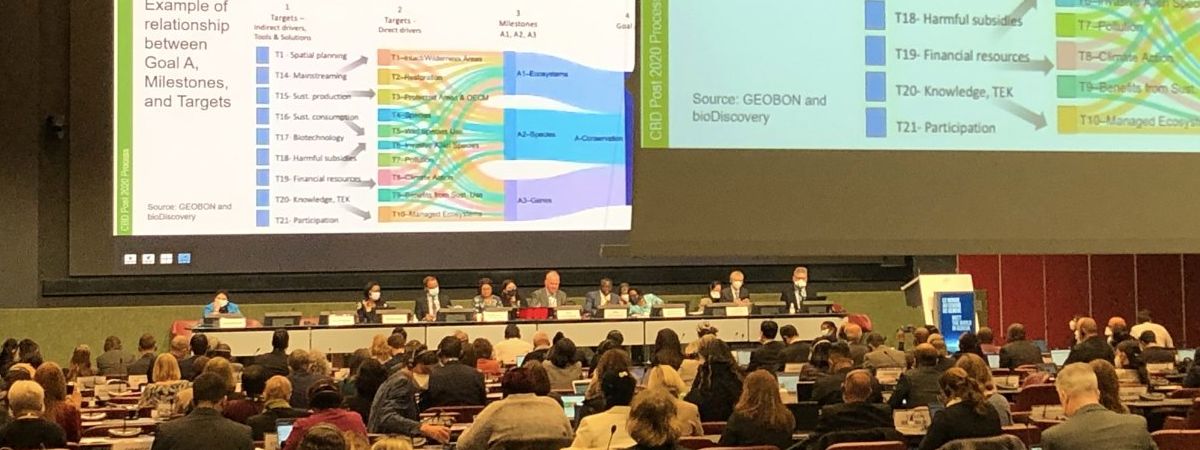
Geneva, March 29, 2022 (09:00 CET)
Excellencies,
After two years of not meeting in person, we all knew that the Geneva talks would be very challenging. But we also knew their importance. Our team
treated this meeting
at a “COP level” of importance: besides all of the technical progress that is needed towards COP15, the Geneva meetings were central in our view for the political impetus and unlocking that they had to provide.
We are of course disappointed, as are many of you too. The slow pace of discussions and the impression of a lack of tangible progress, were frustrating indeed. And yet, we have seen how most of you engaged with genuine effort and good faith: and for that, and on behalf of our almost 70 million members, we would first like to sincerely express our appreciation to you all, to each and every one of you, for the very hard work that you did during these negotiations.
In that spirit of appreciation and gratitude, we want to offer some reflections and ideas, with the hope to keep walking together on the turbulent journey towards reaching the international consensus we need to heal our Planet and our social fabric.
The most important outcome of Geneva: finding back familiarity
We can’t ignore the broader geopolitical context that made things more difficult. Lately, it sometimes feels that we are back to the 1960s, with frontal oppositions between the “North” and the “South”, or the “West” and the “East”. And there are merits and good reasons for this, notably the fact that some key issues from the 1960s have not been resolved yet. In a world that is overflowing with wealth, there are still hundreds of millions of people in poverty, including within high income countries themselves. The pandemic further exposed and aggravated the immoral and obscene depth of inequalities, between and within countries.
Things could have gone differently. Most of the political leadership, back in capitals, did not understand the high stakes of this meeting. We heard from many of you that you wished you had received clearer mandates and instructions. We know that many of you felt lonely in the trenches, but that you did your best nonetheless. And we would like to thank you again for this dedication and encourage you to not give up; not in this moment, and not for a second. The stakes are too high.
Let’s face it. Trust was already deeply harmed before UNFCCC COP26 last November, but developing and developed countries left Glasgow even further divided. In this context, it was the duty of political leaders to do better in their own diplomatic job, to repair trust at their levels, elaborate clearer mandates for their delegations, and thus help discussions be more fluid and constructive here in Geneva. They surely did not treat this meeting at the “COP level” we think it deserved. Nor did the UN system overall, whose leadership was absent too. There was no broker in the room in Geneva. Like many of you, we’re leaving Geneva still wondering who was in charge here.
But that’s not the entire story: the microsociology of the meeting provided very important outcomes. The reconnection between delegates, old and new; the building of interpersonal trust and understanding; getting used to the rhythm and collective exercise of negotiations again; re-learning to work on the texts, with actual deadlines, and planning the next steps together. Just finding back familiarity between people, and with the process, was a challenge in itself, that probably everyone underestimated. Managing to get there, and identifying a way forward, is in itself a very important outcome of the Geneva meetings.
Furthermore, it should be noted that rights-based approaches, especially on the rights of Indigenous Peoples and Local Communities, and on the rights of women and girls, are receiving much more attention now than just a few years ago. Even if there is still a long way to go, there is a clear trend on which to keep building upon.
Before Nairobi, we need an emergency trust-building process
Trust
is what we need to focus on now, with a logic of intensive care. The Geneva meetings have further revealed the structure of the gridlock between developed and developing countries: on one side, no further discussion on financial resources if we don’t discuss ambition thoroughly; on the other, no further discussion on ambition if we don’t discuss financial resources fairly.
To go beyond this blockage, it is an
emergency trust-building process
that we need until Nairobi in late June (21-26, as we write), and it should start right after Geneva. We believe it should have three components:
-
Additional pledges
, especially on finance, from developed countries, during the inter-sessional period. Given the world's inequalities and historical responsibilities, developed countries must take the first step. They have to signal their willingness to do more. It is in particular the responsibility of countries of the so-called “High Ambition Coalition” and the Leaders’ Pledge for Nature, that should now indeed show that they can play the political leadership that they are claiming.
-
Connecting resource mobilisation and transparency
: two of the major items being negotiated are actually intimately connected, and this is still underestimated. The “responsibility and transparency” mechanisms for the post-2020 global biodiversity framework should actually become the institutionalised safe space at the CBD to discuss implementation, and especially on financial resources. This is where collective accountability and visibility on the needs, provision and use of financial resources for biodiversity can be properly developed, to keep building trust throughout the decade. Constructive discussions must happen on this point until Nairobi.
-
Trust building spaces
that are needed for negotiators to further socialise and safely examine options that could help break a deal at COP15. Informal workshops, retreats, and 1:1 conversations should be actively pursued in the next months.
Political leadership must be mobilised, and shaken if need be, to contribute to this effort. Ministers and others cannot wait for their teams to bring them a “turnkey” agreement where they’d just make some marginal adjustments. They must get involved now. The public financial sector, from Bretton Woods institutions to multilateral development banks, must also become much more involved in the process. The private sector, which has mobilised itself and made proposals on the road to COP15, must also show leadership by making more concrete pledges, and being clear on how it’s going to hold itself accountable for achieving them.
This is all the more important because the leadership of China, which holds the COP Presidency, is still
awaited
: in the coming months, China should be clear on the leadership it wants to have, and manage expectations on what they can realistically achieve. And to be frank: if Beijing doesn't want this leadership anymore, President Xi should let someone else do it. China’s silence should be addressed much more loudly, as it is becoming a liability for the process. We can't wait any longer.
This trust-building process must also enable taking aboard the latest developments in science. During the two-year gap imposed by the pandemic, key papers have been published in a range of disciplines. To name a few: research on spatial targets for the
continents
and the
ocean
has further developed; there is a
much historically deeper understanding
of why the rights of Indigenous Peoples and Local Communities should be at the centre of biodiversity action;
proposals for transparency and compliance
for the CBD are becoming more precise. The links with biodiversity and climate are becoming clearer than ever, and the latest report from
IPCC’s Working Group II
has put much emphasis on this and on the importance of rights-based approaches for climate, too. Getting the ambition of the post-2020 global biodiversity framework
where it needs to be
to answer the ecological emergency will require having at its foundation this new body of evidence, as well as the knowledge of Indigenous Peoples and Local Communities who witness first hand the on-going planetary changes. This will take time and resources, too.
Let’s have a good fight
As we leave Geneva, let’s remember that in troubled times, the biodiversity community managed to
restore faith in UN processes
12 years ago at COP10. The post-2020 global biodiversity framework, and its accompanying documents, are meant to be a comprehensive response to the biodiversity crisis. There is still lots of work to do but chances for success are real and we still believe in it. We owe it to ourselves, and even more so to our kids, to keep the world in a shape where we can thrive, and not only survive. The window to get there is reducing by the week. Now that discussions are back on track, thanks to the Geneva meetings, we need to put them on the right track.
Urgently building trust is what we need to do first, to give the pathway to success a chance. We know, deeply in our hearts, that we can do that collectively. And we are ready to engage.
Please know that we want to help, and write to us at
biodiversity@avaaz.org
to tell us how you think we could be useful. We take it as our moral duty to always listen.
It is important to agree to disagree, while always respecting our common humanity. In martial arts, sports, and even in war, trust is necessary to have a good fight. A proper fight. This is key in a negotiation process too. Let’s work hard to rebuild trust in order to fight hard for the best results, in Nairobi, Kunming and beyond.
Before we leave Geneva, and once you arrive in your capital, please remember:
you matter
.
Take care and see you soon.
With hope and determination,
Oscar, Diego, Aleks, Luciana, Isabella, Emilio, Raul, Citla, Huiting, Veturia, Nax and the rest of the Avaaz team